
Square Root Calculator: Decimals, Fractions & Simplest Form
Find the square root of any number as a decimal and in simplest radical form, with every step shown. The calculator also handles cube roots, any nth root, fractions, decimals and negative numbers. It shows which perfect squares your number falls between, too.
Whole numbers, decimals (0.5), fractions (9/25) and negatives (−27) all work.
How to Use the Square Root Calculator
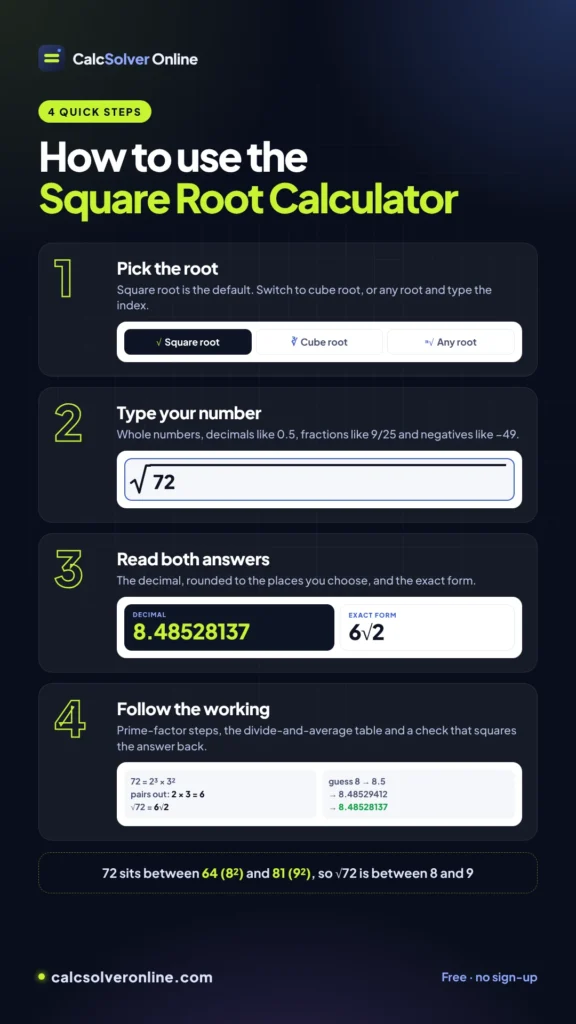
- Pick the root. Square root is the default. Switch to Cube root, or to Any root and type the index, such as 4 for a fourth root.
- Type your number under the root sign. Whole numbers, decimals like 0.5, fractions like 9/25 and negatives like −49 all work.
- Read both answers. The dark box gives the decimal value, rounded to the number of places you choose. The box next to it gives the exact form, such as 6√2.
- Follow the working. Below the answers you’ll see the prime-factor steps, the divide-and-average table and a check that squares the answer back.
What Is a Square Root?
A square root of x is a number that gives x when multiplied by itself. Since 8 × 8 = 64, 8 is a square root of 64. So is −8, because (−8) × (−8) = 64 as well.
Every positive number has two square roots, one positive and one negative. The radical sign √ always means the positive one, called the principal square root. So √64 = 8, and when you need both you write ±√64 = ±8. Zero has only one square root: 0.
The number under the sign is the radicand. For other roots, a small index sits in the crook of the sign: ∛ is a cube root, and a 4 there means a fourth root. In exponent form, √x = x^(1/2).
One rule that often trips people up: √(x²) = |x|, not x. For example, √((−5)²) = √25 = 5.
Perfect Squares and Common Square Roots
A perfect square is a whole number multiplied by itself: 1, 4, 9, 16, 25, 36, 49, 64, 81, 100, 121, 144 and so on. Their square roots are whole numbers. Every other whole number has an irrational square root, a decimal that never ends and never repeats. The square roots 1 to 100 chart lists each one with its simplest form.
| Number | Square root |
|---|---|
| 2 | 1.414214 |
| 3 | 1.732051 |
| 5 | 2.236068 |
| 6 | 2.449490 |
| 7 | 2.645751 |
| 8 | 2.828427 |
| 10 | 3.162278 |
| 12 | 3.464102 |
How to Simplify a Square Root
Simplest radical form keeps the answer exact. Instead of 8.485281…, you write 6√2. To get there:
- Break the number into prime factors: 72 = 2 × 2 × 2 × 3 × 3.
- Each pair of equal factors comes out of the root as one factor. One pair of 2s gives 2 and the pair of 3s gives 3.
- Multiply what came out and leave the rest inside: √72 = 2 × 3 × √2 = 6√2.
Two more: √54 = √(3² × 6) = 3√6, and √27 = √(3² × 3) = 3√3, a multiple of the square root of 3. If no factor appears twice, as with 15 = 3 × 5, the root is already as simple as it gets.
For a cube root, factors come out in groups of three. That’s how ∛192 = ∛(4³ × 3) = 4∛3.
How to Find a Square Root Without a Calculator
Estimate between perfect squares
54 sits between 49 (7²) and 64 (8²), so √54 is between 7 and 8. It’s closer to 49, so the answer is a little above 7. The number line in the calculator shows this for any input.
Divide and average
This is the Babylonian method, also called Heron’s method. Guess, divide your number by the guess, then average the guess and the result. For √54, starting from 7:
- 54 ÷ 7 = 7.714286. Average with 7: 7.357143
- 54 ÷ 7.357143 = 7.339806. Average: 7.348474
- 54 ÷ 7.348474 = 7.348464. Average: 7.348469
Three rounds give six correct decimal places, because each round roughly doubles the number of correct digits.
Long division method
This method finds one digit at a time. Here it is for √54:
- Group the digits in pairs from the decimal point: 54 . 00 00.
- The largest square not over 54 is 49, so the first digit is 7. 54 − 49 leaves 5.
- Bring down 00 to make 500. Double 7 to get 14, then find the largest digit d where 14d × d fits into 500. 143 × 3 = 429, so the next digit is 3. 500 − 429 leaves 71.
- Bring down 00 to make 7,100. Double 73 to get 146. 1,464 × 4 = 5,856 fits, but 1,465 × 5 = 7,325 doesn’t, so the next digit is 4.
That gives √54 ≈ 7.34. Keep going for more places.
Square Roots of Fractions and Decimals
For a fraction, take the root of the top and the bottom: √(9/25) = √9 ÷ √25 = 3/5. If the bottom isn’t a perfect square, multiply the top and bottom by its root so the root ends up on top: √(1/5) = √5/5.
For a decimal, write it as a fraction first. 0.5 = 1/2, so √0.5 = √2/2 ≈ 0.7071. Likewise √0.0004 = √(4/10,000) = 2/100 = 0.02.
Note that for numbers between 0 and 1, the square root is larger than the number itself: √0.25 = 0.5. To turn a decimal answer back into a fraction, use the Fraction Calculator.
Square Roots of Common Decimals
To find the square root of a decimal, move the decimal point in pairs. Moving it two places in the number moves it one place in the root:
- √5 ≈ 2.2361
- √500 ≈ 22.361 (two places right in the number, one place right in the root)
- √0.05 ≈ 0.2236 (two places left, one place left)
√0.5 is not 0.2236. Moving the point only one place breaks the pairs, so 0.5 has a different root: √0.5 = √2/2 ≈ 0.7071. For any decimal not in the table below, type it into the calculator above.
| Number | Square root (4 places) | Exact form |
|---|---|---|
| 0.1 | 0.3162 | √10/10 |
| 0.2 | 0.4472 | √5/5 |
| 0.25 | 0.5 | exact |
| 0.3 | 0.5477 | √30/10 |
| 0.4 | 0.6325 | √10/5 |
| 0.5 | 0.7071 | √2/2 |
| 0.6 | 0.7746 | √15/5 |
| 0.8 | 0.8944 | 2√5/5 |
| 1.2 | 1.0954 | √30/5 |
| 1.5 | 1.2247 | √6/2 |
| 2.25 | 1.5 | exact |
| 2.5 | 1.5811 | √10/2 |
| 4.5 | 2.1213 | 3√2/2 |
| 4.8 | 2.1909 | 2√30/5 |
| 5.5 | 2.3452 | √22/2 |
| 6.25 | 2.5 | exact |
| 7.5 | 2.7386 | √30/2 |
| 8.5 | 2.9155 | √34/2 |
| 10.5 | 3.2404 | √42/2 |
| 12.5 | 3.5355 | 5√2/2 |
Square Root of a Negative Number
No real number squared gives a negative result, so a negative number has no real square root. Mathematicians use the imaginary unit i, where i² = −1, to write one anyway:
- √−49 = 7i
- √−72 = i√72 = 6i√2 ≈ 8.485281i
Cube roots are different. A negative number multiplied by itself three times stays negative, so ∛−27 = −3 is a real answer. The same goes for any odd root. Even roots of negatives, such as the fourth root of −16, have no real value.
Cube Roots and Other Roots
The nth root of x is the number that gives x when raised to the power n. You can write it as x^(1/n). The fifth root of 3,125 is 5, because 5⁵ = 3,125. For roots that don’t come out even, the calculator switches to Newton’s method, the same idea as divide and average, extended to any index. Need a root inside a longer expression? The scientific calculator has √, ∛ and power keys and shows the answer as you type.
Frequently Asked Questions
Is the square root of 2 a rational number?
No. √2 can’t be written as a fraction of two whole numbers. The square root of 2 page shows the proof. Its decimal, 1.41421356…, never ends or repeats. The same is true for the square root of any whole number that isn’t a perfect square.
Why does the calculator say “≈” in the check?
The decimal answer is rounded, so squaring it gives something like 71.99999993 instead of 72. The exact form, 6√2, squares back to exactly 72.
How do I get rid of a square root in an equation?
Get the root alone on one side, then square both sides. For √x = 5, x = 25. Always check your answer in the original equation, because squaring can create solutions that don’t work. For example, √x = −3 has no solution, even though squaring gives x = 9.