
Fraction to Decimal Chart: Halves to 64ths, Thirds, Sevenths & More
This chart lists the decimal for every common fraction, from halves to sixty-fourths, plus thirds, fifths, sixths, sevenths, ninths, tenths, elevenths, twelfths, twentieths and twenty-fifths. The ones you’ll use most are 1/2 = 0.5, 1/4 = 0.25, 3/4 = 0.75, 1/3 = 0.333…, 2/3 = 0.666…, 1/8 = 0.125 and 1/5 = 0.2. To convert any fraction that isn’t here, type it into the converter:
Examples: 3/8, 1 3/4, 0.375, 0.(6) or 0.666… for repeating, 37.5%
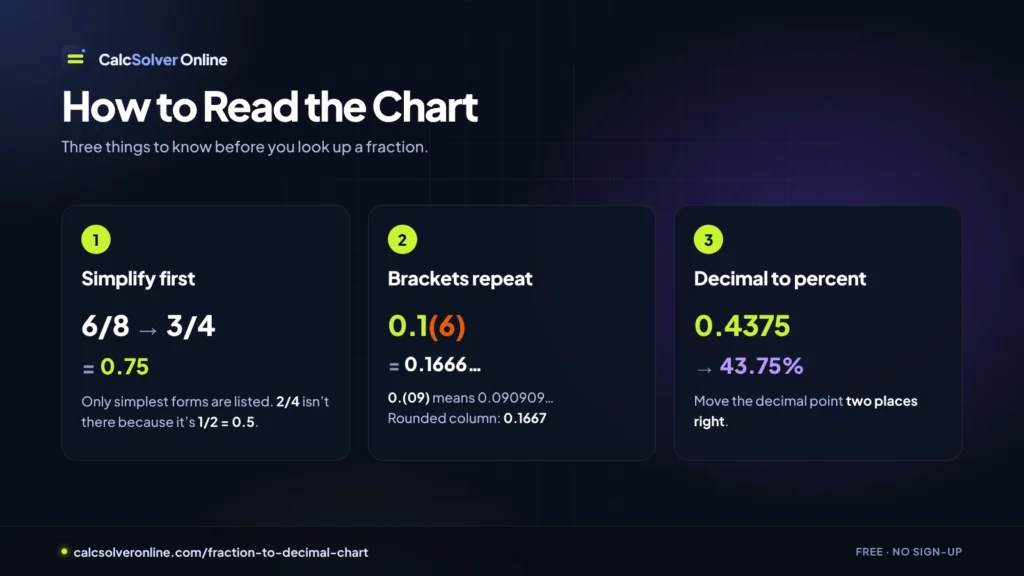
How to Read the Chart
Each table shows the fraction in its simplest form next to its decimal. Fractions such as 2/4 or 6/8 aren’t listed separately, because they have the same decimal as 1/2 and 3/4. To read one off, simplify it first.
Some decimals go on forever. In the chart, the digits in brackets repeat without end, so 0.1(6) means 0.1666… and 0.(09) means 0.090909…. Where a fraction repeats, there’s also a column rounded to four places for everyday use. To turn any decimal in the chart into a percent, move the decimal point two places to the right: 0.4375 becomes 43.75%.
Halves, Quarters and Eighths
| Fraction | Decimal | Percent |
|---|---|---|
| 1/2 | 0.5 | 50% |
| 1/4 | 0.25 | 25% |
| 3/4 | 0.75 | 75% |
| 1/8 | 0.125 | 12.5% |
| 3/8 | 0.375 | 37.5% |
| 5/8 | 0.625 | 62.5% |
| 7/8 | 0.875 | 87.5% |
Every eighth is a multiple of 0.125, so you can count up in steps: 0.125, 0.25, 0.375, 0.5 and so on. That makes eighths the easiest set to work out in your head. On an imperial tape measure, the eighth-inch marks are shorter than the inch, half-inch and quarter-inch marks, and longer than the sixteenth marks.
Sixteenths and Thirty-Seconds, With Millimetres
These are the fractions on an imperial ruler or tape measure. The millimetre column assumes the fraction is of an inch, using 1 inch = 25.4 mm exactly.
| Fraction | Decimal | Millimetres |
|---|---|---|
| 1/16 | 0.0625 | 1.5875 |
| 3/16 | 0.1875 | 4.7625 |
| 5/16 | 0.3125 | 7.9375 |
| 7/16 | 0.4375 | 11.1125 |
| 9/16 | 0.5625 | 14.2875 |
| 11/16 | 0.6875 | 17.4625 |
| 13/16 | 0.8125 | 20.6375 |
| 15/16 | 0.9375 | 23.8125 |
| 1/32 | 0.03125 | 0.79375 |
| 3/32 | 0.09375 | 2.38125 |
| 5/32 | 0.15625 | 3.96875 |
| 7/32 | 0.21875 | 5.55625 |
| 9/32 | 0.28125 | 7.14375 |
| 11/32 | 0.34375 | 8.73125 |
| 13/32 | 0.40625 | 10.31875 |
| 15/32 | 0.46875 | 11.90625 |
| 17/32 | 0.53125 | 13.49375 |
| 19/32 | 0.59375 | 15.08125 |
| 21/32 | 0.65625 | 16.66875 |
| 23/32 | 0.71875 | 18.25625 |
| 25/32 | 0.78125 | 19.84375 |
| 27/32 | 0.84375 | 21.43125 |
| 29/32 | 0.90625 | 23.01875 |
| 31/32 | 0.96875 | 24.60625 |
Only the odd tops are listed. Even ones simplify: 6/16 is 3/8 and 12/32 is also 3/8. Every sixteenth sits exactly halfway between two eighths, so 9/16 = 0.5 + 0.0625 = 0.5625. Every thirty-second sits halfway between two sixteenths.
Sixteenths also turn up in weight. A pound is 16 ounces, so 1 oz = 1/16 lb = 0.0625 lb, and 12 oz = 3/4 lb = 0.75 lb.
Sixty-Fourths
Machinists, drill bit sets and some precision rulers go down to 1/64 inch. Each sixty-fourth adds 0.015625:
| Fraction | Decimal | Millimetres |
|---|---|---|
| 1/64 | 0.015625 | 0.396875 |
| 3/64 | 0.046875 | 1.190625 |
| 5/64 | 0.078125 | 1.984375 |
| 7/64 | 0.109375 | 2.778125 |
| 9/64 | 0.140625 | 3.571875 |
| 11/64 | 0.171875 | 4.365625 |
| 13/64 | 0.203125 | 5.159375 |
| 15/64 | 0.234375 | 5.953125 |
| 17/64 | 0.265625 | 6.746875 |
| 19/64 | 0.296875 | 7.540625 |
| 21/64 | 0.328125 | 8.334375 |
| 23/64 | 0.359375 | 9.128125 |
| 25/64 | 0.390625 | 9.921875 |
| 27/64 | 0.421875 | 10.715625 |
| 29/64 | 0.453125 | 11.509375 |
| 31/64 | 0.484375 | 12.303125 |
| 33/64 | 0.515625 | 13.096875 |
| 35/64 | 0.546875 | 13.890625 |
| 37/64 | 0.578125 | 14.684375 |
| 39/64 | 0.609375 | 15.478125 |
| 41/64 | 0.640625 | 16.271875 |
| 43/64 | 0.671875 | 17.065625 |
| 45/64 | 0.703125 | 17.859375 |
| 47/64 | 0.734375 | 18.653125 |
| 49/64 | 0.765625 | 19.446875 |
| 51/64 | 0.796875 | 20.240625 |
| 53/64 | 0.828125 | 21.034375 |
| 55/64 | 0.859375 | 21.828125 |
| 57/64 | 0.890625 | 22.621875 |
| 59/64 | 0.921875 | 23.415625 |
| 61/64 | 0.953125 | 24.209375 |
| 63/64 | 0.984375 | 25.003125 |
Thirds, Sixths, ninths, and Twelfths
All of these repeat, because their bottoms have a factor of 3.
| Fraction | Exact decimal | Rounded (4 places) | Percent |
|---|---|---|---|
| 1/3 | 0.(3) | 0.3333 | ≈ 33.33% |
| 2/3 | 0.(6) | 0.6667 | ≈ 66.67% |
| 1/6 | 0.1(6) | 0.1667 | ≈ 16.67% |
| 5/6 | 0.8(3) | 0.8333 | ≈ 83.33% |
| 1/9 | 0.(1) | 0.1111 | ≈ 11.11% |
| 2/9 | 0.(2) | 0.2222 | ≈ 22.22% |
| 4/9 | 0.(4) | 0.4444 | ≈ 44.44% |
| 5/9 | 0.(5) | 0.5556 | ≈ 55.56% |
| 7/9 | 0.(7) | 0.7778 | ≈ 77.78% |
| 8/9 | 0.(8) | 0.8889 | ≈ 88.89% |
| 1/12 | 0.08(3) | 0.0833 | ≈ 8.33% |
| 5/12 | 0.41(6) | 0.4167 | ≈ 41.67% |
| 7/12 | 0.58(3) | 0.5833 | ≈ 58.33% |
| 11/12 | 0.91(6) | 0.9167 | ≈ 91.67% |
Ninths are the easiest to remember: the top digit simply repeats, so 4/9 = 0.444… and 7/9 = 0.777…. Following the same pattern, 9/9 would be 0.999…, which is exactly 1.
Twelfths are a quarter of a third. 5/12 is halfway between 1/3 and 1/2, at 0.41(6). They’re also the fractions of a foot: 1 inch is 1/12 ft, or about 0.0833 ft, and 9 inches is 3/4 ft, or 0.75 ft.
Fifths, Tenths and Twentieths
| Fraction | Decimal | Percent |
|---|---|---|
| 1/5 | 0.2 | 20% |
| 2/5 | 0.4 | 40% |
| 3/5 | 0.6 | 60% |
| 4/5 | 0.8 | 80% |
| 1/10 | 0.1 | 10% |
| 3/10 | 0.3 | 30% |
| 7/10 | 0.7 | 70% |
| 9/10 | 0.9 | 90% |
| 1/20 | 0.05 | 5% |
| 3/20 | 0.15 | 15% |
| 7/20 | 0.35 | 35% |
| 9/20 | 0.45 | 45% |
| 11/20 | 0.55 | 55% |
| 13/20 | 0.65 | 65% |
| 17/20 | 0.85 | 85% |
| 19/20 | 0.95 | 95% |
Fifths go up in steps of 0.2, tenths in steps of 0.1 and twentieths in steps of 0.05. Twentieths are also how tips and discounts are often quoted: 3/20 is a 15% tip.
Twenty-Fifths
Scores out of 25 are easy to convert, because 25 × 4 = 100. Multiply the top by 4 and you have the percent:
| Fraction | Decimal | Percent |
|---|---|---|
| 1/25 | 0.04 | 4% |
| 2/25 | 0.08 | 8% |
| 3/25 | 0.12 | 12% |
| 4/25 | 0.16 | 16% |
| 6/25 | 0.24 | 24% |
| 7/25 | 0.28 | 28% |
| 8/25 | 0.32 | 32% |
| 9/25 | 0.36 | 36% |
| 11/25 | 0.44 | 44% |
| 12/25 | 0.48 | 48% |
| 13/25 | 0.52 | 52% |
| 14/25 | 0.56 | 56% |
| 16/25 | 0.64 | 64% |
| 17/25 | 0.68 | 68% |
| 18/25 | 0.72 | 72% |
| 19/25 | 0.76 | 76% |
| 21/25 | 0.84 | 84% |
| 22/25 | 0.88 | 88% |
| 23/25 | 0.92 | 92% |
| 24/25 | 0.96 | 96% |
The same trick works for fiftieths: multiply the top by 2. So 37/50 = 74/100 = 0.74.
Elevenths: A Two-Digit Pattern
| Fraction | Decimal | Percent |
|---|---|---|
| 1/11 | 0.(09) | ≈ 9.09% |
| 2/11 | 0.(18) | ≈ 18.18% |
| 3/11 | 0.(27) | ≈ 27.27% |
| 4/11 | 0.(36) | ≈ 36.36% |
| 5/11 | 0.(45) | ≈ 45.45% |
| 6/11 | 0.(54) | ≈ 54.55% |
| 7/11 | 0.(63) | ≈ 63.64% |
| 8/11 | 0.(72) | ≈ 72.73% |
| 9/11 | 0.(81) | ≈ 81.82% |
| 10/11 | 0.(90) | ≈ 90.91% |
The repeating pair is always the top number times 9. For 7/11, 7 × 9 = 63, so the decimal is 0.636363….
Sevenths
| Fraction | Exact decimal | Rounded (4 places) | Percent |
|---|---|---|---|
| 1/7 | 0.(142857) | 0.1429 | ≈ 14.29% |
| 2/7 | 0.(285714) | 0.2857 | ≈ 28.57% |
| 3/7 | 0.(428571) | 0.4286 | ≈ 42.86% |
| 4/7 | 0.(571428) | 0.5714 | ≈ 57.14% |
| 5/7 | 0.(714285) | 0.7143 | ≈ 71.43% |
| 6/7 | 0.(857142) | 0.8571 | ≈ 85.71% |
Every seventh repeats the same six digits, 142857, starting at a different point. The 6/7 page explains why.
Minutes as Decimal Hours
Timesheets and payroll systems often want hours as decimals. Because an hour has 60 minutes, every 5 minutes is 1/12 of an hour:
| Minutes | Fraction of an hour | Decimal hours |
|---|---|---|
| 5 | 1/12 | 0.0833 |
| 10 | 1/6 | 0.1667 |
| 15 | 1/4 | 0.25 |
| 20 | 1/3 | 0.3333 |
| 25 | 5/12 | 0.4167 |
| 30 | 1/2 | 0.5 |
| 35 | 7/12 | 0.5833 |
| 40 | 2/3 | 0.6667 |
| 45 | 3/4 | 0.75 |
| 50 | 5/6 | 0.8333 |
| 55 | 11/12 | 0.9167 |
So 7 hours 40 minutes is 7.67 hours, not 7.40. Writing 7.40 is a common slip that pays 16 minutes less than was worked.
Reading Mistakes to Avoid
- Using a rounded value as if it were exact. 1/3 is not 0.33. Three lots of 0.33 make 0.99, not 1. Keep the fraction, or at least four decimal places, until the last step.
- Dropping a zero. 1/16 is 0.0625, not 0.625. 0.625 is 5/8, ten times bigger.
- Reading the wrong column on a ruler. 3/16 (0.1875) and 3/8 (0.375) look alike at a glance, but one is twice the other.
- Mixed numbers. Keep the whole number in front and add the decimal part: 2 3/8 = 2 + 0.375 = 2.375, and 1 5/16 = 1.3125.
Going Backwards: The Nearest Fraction to a Decimal
Measurements often come out as decimals that don’t match any fraction exactly. To mark them on a ruler, find the nearest sixteenth or thirty-second. Multiply the decimal by 16 (or 32), round to a whole number, and put that over 16 (or 32):
| Decimal | × 16, rounded | Nearest 16th | × 32, rounded | Nearest 32nd |
|---|---|---|---|---|
| 0.1 | 2 | 1/8 (0.125) | 3 | 3/32 (0.09375) |
| 0.3 | 5 | 5/16 (0.3125) | 10 | 5/16 (0.3125) |
| 0.45 | 7 | 7/16 (0.4375) | 14 | 7/16 (0.4375) |
| 0.66 | 11 | 11/16 (0.6875) | 21 | 21/32 (0.65625) |
| 0.83 | 13 | 13/16 (0.8125) | 27 | 27/32 (0.84375) |
Thirty-seconds get you closer, but they’re harder to see on a tape measure. For 0.66 the nearest sixteenth is 0.0275 out, while the nearest thirty-second is only 0.00375 out. When a decimal does come from an exact fraction, such as 0.375, the Fraction to Decimal and Percent Converter turns it back into the exact fraction, 3/8.
Showing Fractions in a Spreadsheet
In Excel or Google Sheets, type =7/16 and the cell shows 0.4375. To go the other way and display a decimal as the nearest fraction, use a fraction number format. In Excel, choose Format Cells, then Fraction, then “As sixteenths (8/16)”, and 0.66 appears as 11/16. The custom format # ??/32 gives the nearest thirty-second instead, so 0.66 shows as 21/32, matching the table above. The cell still holds the exact decimal, so calculations aren’t affected.
Patterns That Save You Memorising
- Halving moves you down the chart. Half of 0.5 is 0.25, half of that is 0.125, then 0.0625 and 0.03125. Each is the next power of two: 1/2, 1/4, 1/8, 1/16, 1/32.
- Complements add to 1. If you know 3/8 = 0.375, then 5/8 = 1 − 0.375 = 0.625. The same works for 1/12 and 11/12: 0.0833… and 0.9166….
- Multiply the unit fraction. 5/16 is 5 × 0.0625 = 0.3125, and 7/20 is 7 × 0.05 = 0.35.
For adding, subtracting or simplifying the fractions themselves, use the Fraction Calculator.