
Final Grade Calculator – What Do I Need on My Final?
Want to know what you need on your final? Enter your current grade, how much the final is worth and the grade you want. The calculator gives you the exact score to aim for. It also shows the lowest and highest class grade you can still finish with, and what you need for an A, B, C or a pass.
Grade scale & rounding
D is used as the passing line. Change any cutoff to match your syllabus.
How to Use the Final Grade Calculator
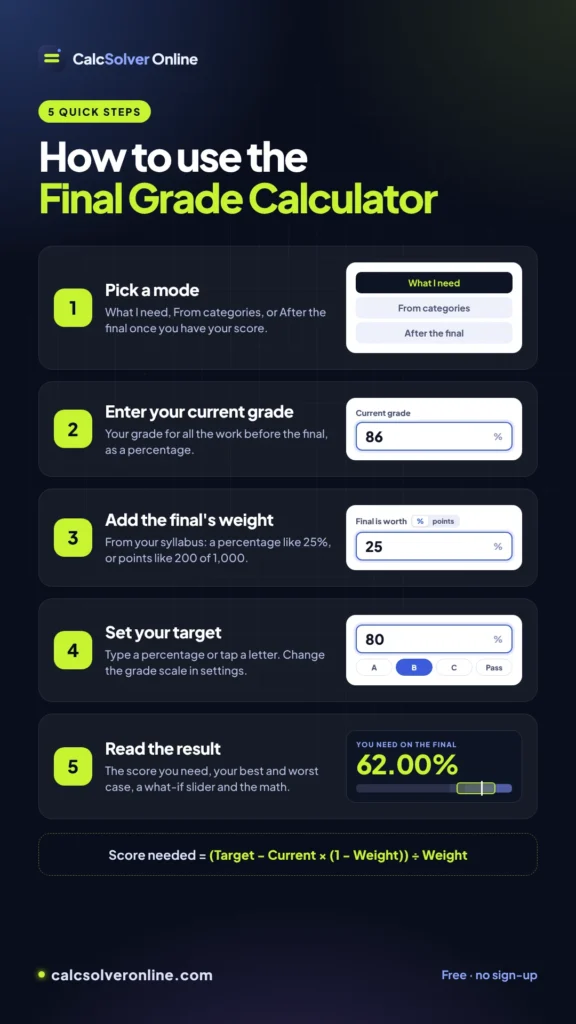
- Pick a mode. Use What I need if you know your current grade. Use From categories if your gradebook is split into homework, quizzes and tests. Use After the final once you have your exam score.
- Enter your current grade as a percentage. This should be your grade for all the work before the final.
- Enter what the final is worth. Your syllabus lists it as a percentage, like 25%, or as points, like 200 out of 1,000. Switch to “points” for the second kind.
- Set your target. Type a percentage or tap a letter. The letter buttons follow the grade scale in the settings, which you can change.
- Read the result. You get the score you need, a bar showing your best and worst case, a slider to test any score, and the math step by step.
Final Grade Formula
The calculator rearranges the weighted average that builds your class grade:
Score needed on final = (Target grade − Current grade × (1 − Final weight)) ÷ Final weight
Write the final weight as a decimal, so 25% becomes 0.25.
Example: your grade is 86% and the final is worth 25%. You want to finish with at least 80%, a B.
- The work before the final counts for 75% of the grade: 86 × 0.75 = 64.5
- Points you still need: 80 − 64.5 = 15.5
- Divide by the final weight: 15.5 ÷ 0.25 = 62%
A 62% on the final keeps your B. To find your class grade after the exam, run it the other way: class grade = current grade × (1 − weight) + final score × weight.
What Your Result Means
Between 0% and 100%: the target is reachable, and the number is the lowest score that gets you there.
Above 100%: the target can’t be reached on the final alone. Say you have 80% with a 30% final and want 90%. You would need 113.33%. A perfect score lifts you to 86%, so a B is the ceiling unless your teacher offers extra credit or a curve.
0% or below: that grade is already secured. Even a zero on the final keeps you there.
The range bar shows both ends. Take the 86% student with a 25% final. A zero on the exam drops them to 64.5%. A perfect score lifts them to 89.5%. Every possible result falls inside that window, so you can see at a glance how much the final can move your grade.
Working Out Your Current Grade From Categories
Many classes don’t show one running grade. They weight categories instead, such as homework 20%, quizzes 15% and tests 40%, with the final worth the remaining 25%. In From categories mode, enter your average score and weight for each category. The calculator then finds your current grade:
(92 × 20 + 85 × 15 + 78 × 40) ÷ 75 = 83.13%
It divides by 75, not 100, because the other 25% belongs to the final you haven’t taken. The calculator also adds up your weights and the final weight. If they don’t come to 100%, check the syllabus before trusting the answer.
Watch for work that isn’t graded yet. The formula assumes the final is the only thing left. If a 10% project is still open, your current grade doesn’t cover it. Count that project as a category with your best guess, or treat it as part of the remaining weight.
When the Final Is Worth Points
Some teachers grade in points instead of percentages. To get the final’s weight, divide the final’s points by the total points in the class. A 200-point final in a 1,000-point class is worth 200 ÷ 1,000 = 20%. Switch the weight box to “points” and the calculator does this for you.
With an 86% going in, that student needs 56% on the final to keep an 80%.
Letter Grade Scale
Many schools in the US use this 10-point scale. It is the calculator’s default:
| Letter | Percentage |
|---|---|
| A | 90–100% |
| B | 80–89% |
| C | 70–79% |
| D | 60–69% |
| F | Below 60% |
Plus and minus grades split each band further. Many schools set A− at 90–92% and B+ at 87–89%. Others start a pass at 65% or 70%, and colleges add their own passing grade rules for majors and prerequisites. Use the settings to match your syllabus, since every letter result depends on these cutoffs.
Does Your Teacher Round Grades?
Some teachers round 89.5% up to 90%, and some don’t. Turn on the rounding option and the calculator aims for half a point below the cutoff.
It can make a real difference. With an 86% and a 25% final, an A at a strict 90% needs 102%, which is out of reach. If 89.5% rounds up, you need exactly 100%. That’s hard, but possible. Ask your teacher before you count on it.
Frequently Asked Questions
How much can a final exam raise my grade?
The most it can add is the final weight × (100 − your current grade). With a 70% and a 30% final, a perfect score adds 9 points and gives you a 79%.
Can a final exam drop me from an A to a B?
Yes. With a 92% and a 20% final, you need at least 82% on the exam to stay at 90%. Anything lower moves you into the B range.
What if the final is my only grade?
Set your current grade to 0 and the weight to 100%. The score you need then equals your target grade.
What if my final replaces my lowest test score?
This calculator assumes a fixed final weight. If your final can replace a test, work out your grade both ways and use the higher one. You can also ask your teacher which rule applies.
Related Calculators
Once you know your class grades, the GPA Calculator turns them into a term or cumulative GPA. For quick percent checks, like what 42 out of 50 is, use the Percentage Calculator. For anything else, the free scientific calculator on calcsolveronline.com shows the answer while you type.